
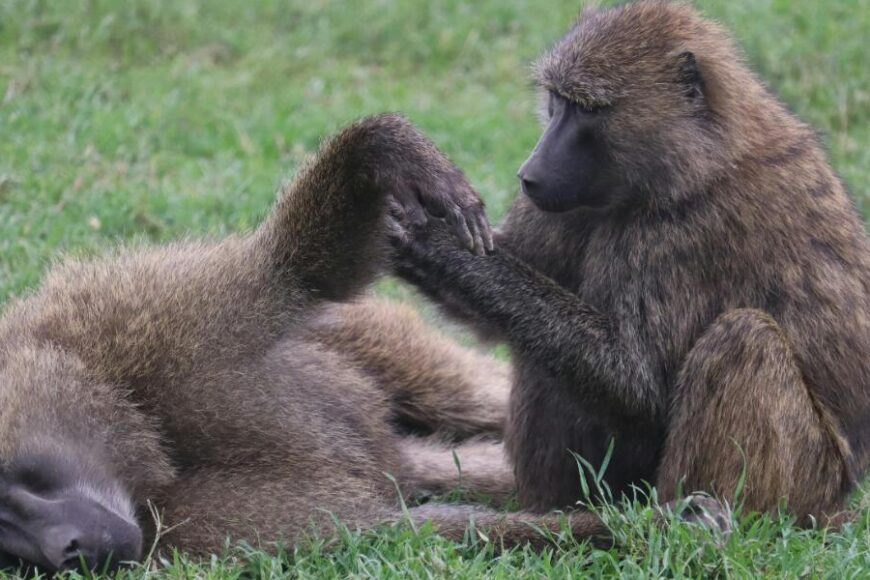
In the beautiful landscapes of East Africa—places like Kenya, Uganda, and Tanzania—many animals live together in forests, mountains, and wide savannas. One of the most interesting animals in this region is the olive baboon. They are smart, strong monkeys that live in large groups called troops.
Baboons are so fascinating that watching them feels like taking a celebrity tour. Each one has a personality — the bossy one, the troublemaker, the gentle groomer — and you can look for hours as they chatter, argue, play, and pose like stars on the savanna stage.
Size of a Baboon
Baboons are some of the largest monkeys in the world.
Adult Male Olive Baboon
Body length: 60–86 cm (24–34 inches)
Tail length: about 40–60 cm (16–24 inches)
Standing height on hind legs: up to 90 cm (about 3 feet)
Adult Female Olive Baboon
Body length: 50–76 cm (20–30 inches)
Tail length: similar to males
Standing height: shorter and lighter than males
Fact: Males are almost twice as big as females, which is rare for monkeys and shows how strong male baboons can be.
If a weaker baboon be attacked by a stronger baboon the weaker baboon will either (a) present his hrump fanny I believe is the word, gentlemen, heh heh for passive intercourse or (b) if he is a different type baboon more extrovert and well-adjusted, lead an attack on an even weaker baboon if he can find one.
Weight of a Baboon
Weight varies depending on region and food availability.
Adult Males:
20–30+ kg (44–66+ pounds)
Some very large males can reach 35 kg (77 lbs).
Adult Females:
10–15 kg (22–33 pounds)
Because males are much heavier and muscular, they often act as protectors of the troop.
Why Size and Power Matter in the Wild
Baboons need their strength for:
defending against predators (like leopards, hyenas, eagles)
competing with other males for dominance
protecting young baboons
accessing tough foods like roots, bark, and even beehives
Their powerful bodies help them survive in many environments—from forests to savannas to rocky cliffs.
Kibabu was an olive baboon (Papio anubis), just like the ones found across East Africa. But he looked a bit different. His fur had golden streaks, and when sunlight hit him, he looked shiny—almost like he was covered in honey.
Real Animal Fact:
Olive baboons usually have brown or greenish-brown fur, but sometimes their fur picks up dust, pollen, or tree sap that makes it look lighter.
Kibabu lived with a troop of about 40 baboons. They ate fruits, seeds, roots, insects, and sometimes small animals. But Kibabu had a favorite food: wild honey.
Kibabu wasn’t the only baboon who liked honey. All baboons enjoy it because:
It tastes sweet
It gives them lots of energy
The wax and larvae inside the hive are nutritious
Real Animal Fact:
Baboons sometimes raid beehives using their tough hands and thick fur to protect themselves from stings.
But Kibabu had a special skill—he could gather honey without making the bees angry.
One morning, Kibabu found a big beehive in an old fig tree. The bees were buzzing loudly, but Kibabu didn’t smash the hive like other animals might.
Instead, he used a smart method:
He covered his hands with dust.
This helped calm the bees, the same way smoke does.He gently removed small pieces of bark.
This opened the hive slowly, without destroying it.He blew soft air through his lips.
Baboons use this sound to relax each other, and the bees seemed less upset.
Kibabu took only a small amount of honey and left the rest for the bees to rebuild.
Real Animal Fact:
Some primates use plants or dust to keep insects away, showing creative problem-solving.
Nearby lived two children, Naserian and her brother Tembo. One day their goats wandered off into the forest. While looking for them, the children became lost among the tall trees.
Suddenly they heard branches shifting.
A huge golden baboon stepped out.
But instead of scaring them, Kibabu walked ahead and looked back as if saying, “Follow me.”
The children followed, and he led them straight to their goats, standing safely under an acacia tree. Then Kibabu climbed a fig tree and dropped down a small piece of honeycomb for the children to taste.
They returned home happily and told their story.
The village elders listened carefully and said:
“A baboon who treats the bees gently shows us how nature works together.”
From that day, the villagers understood that:
Bees need safe places to live
Baboons depend on bees for food
Humans, animals, and insects all share the same environment
They began protecting wild beehives instead of destroying them.
One year, outside honey harvesters arrived. They used axes and smoke to take honey from many trees. This harmed the bees and removed food that the baboons needed.
Kibabu saw his troop struggling. The young baboons were hungry, and the forest was growing quiet.
Real Environmental Fact:
When humans destroy too many wild hives or cut down trees, both bees and animals lose important resources.
One morning, while the harvesters were cutting a hive, Kibabu appeared on a high rock and made a loud bark. Behind him stood his entire troop—mothers, juveniles, and older males.
Naserian, now older and helping her community with beekeeping, arrived and told the harvesters:
“This forest belongs to the bees, the baboons, and us. We must all share it.”
The harvesters agreed to stop. Instead, they learned to build sustainable log hives, which give honey without destroying the bees’ home.
One bright morning, while the troop foraged near a cluster of acacia trees, the air suddenly filled with the sharp alarm call of a hornbill. Then came the scent—musky, dangerous, unmistakable.
Leopard.
Chaos rippled through the troop. Mothers pulled infants to their chests. Juveniles scrambled into thorny bushes. The males froze, uncertain.
Makari’s heart pounded. He climbed a large boulder, the same way Kibabu would have done in his prime. The leopard crept closer, its golden eyes fixed on the smallest baboons.
Makari could run. He could hide.
Instead, he chose courage.
Makari drew a deep breath from his chest and let out a powerful rallying call that echoed across the savanna. Birds burst from the trees. Every baboon turned.
He signaled the males with sharp gestures—quick movements taught to him by Kibabu. They responded instantly, spreading out, flanking the leopard from both sides.
The leopard growled, surprised by their unity.
Makari kept calling, hopping from rock to rock, guiding the troop like a seasoned commander. Dust rose in swirling clouds as the males charged as one. Startled and outmaneuvered, the leopard finally slipped back into the tall grass and vanished.
Silence settled. Then came the chatter—admiration, relief, pride.
Kibabu climbed the boulder to stand beside his son. His fur was gray, his body tired, but his eyes gleamed with pride.
“Makari,” he said softly, “I led our troop with strength. But today, you led with heart and wisdom. Your legacy begins now.”
Makari finally understood: he didn’t need to fill Kibabu’s footprints. He only needed to walk beside them.
From that day forward, the baboons of Olduvai Gorge spoke of Makari the Pathfinder, the baboon who found his courage among the stones of Tanzania.
And Kibabu’s legacy lived on—stronger than ever.