Kitulo National Park – God's Garden
The area was initially visited by explorer Fredrick Elton in 1870. After a period in the 1960s when it was used unsuccessfully by the UN for wheat and sheep schemes, it was converted into a diary farm in 1972. Due to conservation concerns, part of the farm, along with the Livingstone and Nhumbe Forest Reserves, was finally declared Kitulo National Park on September 16, 2005.
The climate is temperate, influenced by altitude and proximity to Lake Nyasa.
Maximum daily temperatures are cool ($14.5^\circ\text{C}$ to $18^\circ\text{C}$).
Minimum temperatures are low ($7^\circ\text{C}$ to $8^\circ\text{C}$), and can drop as low as $0.5^\circ\text{C}$ during June to August, which is the period when frost occurs.
The rainy season runs from October to May, with average annual rainfall around $1,600\text{ mm}$.
The park is only accessible by road.
By Air: Travelers typically fly into Songwe Airport (which can handle commercial jets serving Mbeya City), then complete the remaining distance by road ($90\text{ km}$ via Isyonje or $125\text{ km}$ via Chimala).
By Road: Key access routes include Mbeya City ($70\text{ km}$ via Isyonje) and Njombe town.
By Rail: It is possible to use the TAZARA railway to Iyunga and Makambako stations, followed by public transport connections.
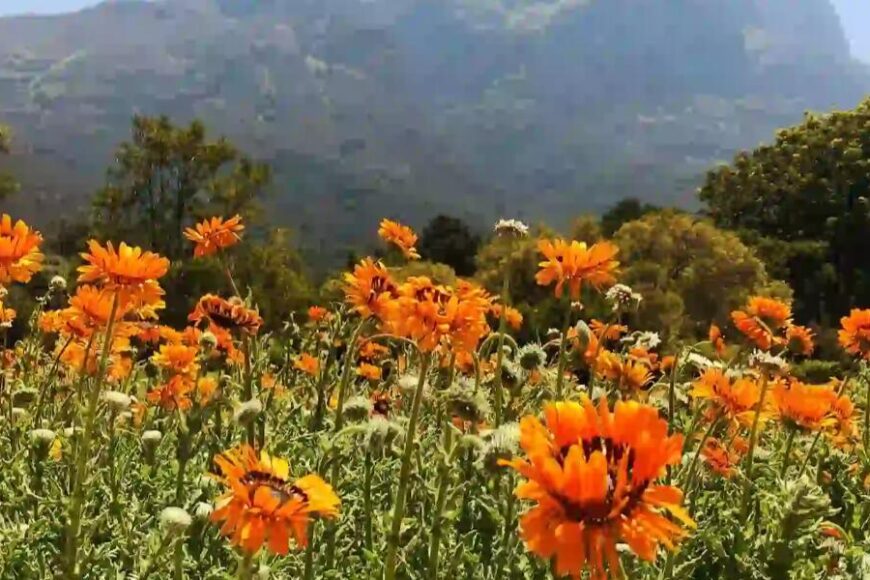
The park’s special significance lies in its incredible montane grassland ecology and unique flora. It is famous for its extensive displays of wildflowers, particularly orchids, which bloom spectacularly from October to April.
Kitulo is a haven for botanists and birdwatchers, hosting several unique species:
Mammals: The critically rare Kipunji monkey is a key primate. Visitors can also spot Mountain Reedbuck, Eland, and occasionally African Wild Dogs or Leopard.
Birds: It is home to the endangered Blue Swallow and Tanzania’s only population of Denham’s Bustard. Other unique species include the Kipengere Seedeater and the Njombe Cisticola.
Reptiles/Invertebrates: It has a variety of reptiles (chameleons, snakes) and numerous species of butterflies, which are vital pollinators.